
If you earn income that is not subject to withholding, whether from self-employment, a side business, rental properties, or investments, you are likely required to make quarterly estimated tax payments to both the IRS and the California Franchise Tax Board (FTB). Missing these payments, or underpaying them, results in penalties that add up fast.
This article breaks down who must pay estimated taxes, how to calculate what you owe, the key differences between California and federal requirements, exact due dates for 2026, safe harbor rules, and every payment method available to you.
Contact Clear Peak Accounting today to get help with your estimated tax payments and avoid costly penalties.
Key takeaways:
- Quarterly estimated tax payments are required if you expect to owe $1,000+ to the IRS or $500+ to the California FTB after withholding and credits
- California uses a 30/40/0/30 payment split, meaning no third-quarter payment is due, unlike the federal 25/25/25/25 schedule
- Safe harbor rules let you avoid underpayment penalties by paying 100% of your prior year’s tax liability
- 2026 due dates: April 15, June 15, September 15 (federal only), and January 15, 2027
- Payment options include IRS Direct Pay, EFTPS, California Web Pay, and Form 540-ES vouchers
Who Must Make Quarterly Estimated Tax Payments?
Estimated tax payments apply to anyone who expects to owe a certain threshold of tax after accounting for withholding and credits.
Federal (IRS) requirements:
You must make estimated payments if you expect to owe $1,000 or more in federal income tax for the year, and your withholding and refundable credits will cover less than:
- 90% of your current year’s tax liability, or
- 100% of your prior year’s tax liability (110% if your adjusted gross income exceeded $150,000, or $75,000 if married filing separately)
California (FTB) requirements:
California has a lower threshold. You must make estimated payments if you expect to owe at least:
- $500 (or $250 if married/registered domestic partner filing separately)
And your withholding and credits will cover less than the smaller of:
- 90% of your current year’s tax, or
- 100% of your prior year’s tax (including alternative minimum tax)
Who Typically Needs to Pay
The following types of taxpayers commonly have estimated tax payment obligations:
- Self-employed individuals and freelancers – No employer is withholding taxes from your income
- Small business owners – Sole proprietors, partners, and S Corp shareholders with pass-through income
- Landlords and real estate investors – Rental income is not subject to withholding
- Investors – Dividends, capital gains, and interest income may trigger estimated tax requirements
- W-2 employees with side income – If your employer withholding does not cover your full tax liability
- Retirees – Pension and retirement distributions may not have sufficient withholding
If you operate a business in California and your income flows through to your personal return, which is the case for LLCs, S Corps, and partnerships, estimated tax payments are almost certainly part of your obligation.
How to Calculate Quarterly Estimated Tax Payments
Calculating your estimated tax requires projecting your total income, deductions, credits, and tax liability for the year.
Federal Calculation
The IRS provides Form 1040-ES with a worksheet to estimate your quarterly payments. The basic process:
- Estimate your adjusted gross income for the year
- Subtract your expected deductions (standard or itemized)
- Calculate the tax on your taxable income using the current tax brackets
- Subtract expected credits (child tax credit, education credits, etc.)
- Subtract any expected withholding from W-2 jobs or other sources
- The remaining balance is your estimated tax liability
Divide the result by four for equal quarterly installments, or use the annualized income installment method if your income is uneven throughout the year.
California Calculation
California uses Form 540-ES with its own estimated tax worksheet. The process is similar, but the payment percentages per quarter differ significantly from the federal schedule (covered in the due dates section below).
For businesses, the calculation involves estimating your California-source income and applying the appropriate state tax rate. If your business is structured as a pass-through entity, your estimated payments are made on your personal return, not at the entity level, unless you are electing into the Pass-Through Entity (PTE) elective tax.
A CPA who specializes in business tax planning can help you project income accurately and avoid both underpayment penalties and unnecessary overpayment.
California vs. Federal Estimated Tax Payments: Key Differences
This is where many California business owners get tripped up. The state and federal systems are not identical.
| Feature | Federal (IRS) | California (FTB) |
|---|---|---|
| Minimum threshold | $1,000 owed | $500 owed ($250 if MFS) |
| Payment schedule | 4 equal payments (25% each) | Unequal: 30%, 40%, 0%, 30% |
| Q3 payment | Required (25%) | Not required ($0 due) |
| Safe harbor (prior year) | 100% (110% if AGI > $150K) | 100% of prior year tax |
| Penalty calculation | Per-period basis | Per-period basis |
| Forms | 1040-ES | 540-ES |
| Payment portal | IRS Direct Pay / EFTPS | FTB Web Pay |
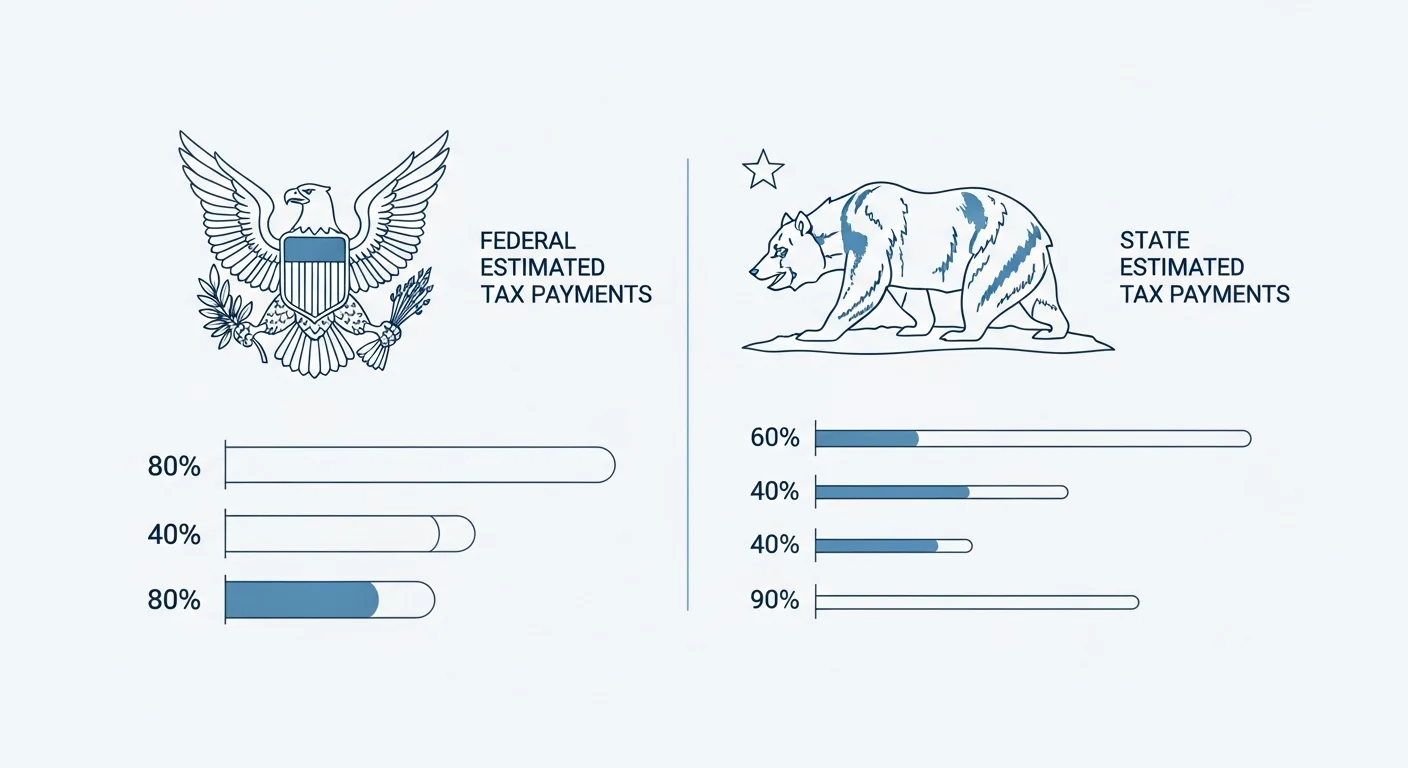
The most important distinction is the payment schedule. While the IRS expects four equal payments of 25%, California uses a 30/40/0/30 split. This means you pay nothing in the third quarter for California purposes, but your second-quarter payment is larger at 40% of the annual estimate.
Many business owners forget this difference and either underpay the second California installment or overpay the third. Both mistakes have consequences: underpayment triggers penalties, and overpayment ties up cash you could use elsewhere.
2026 Quarterly Estimated Tax Payment Due Dates
Here are the exact due dates for both federal and California estimated tax payments in 2026.
Federal Due Dates (IRS)
| Quarter | Income Period | Due Date | Percentage |
|---|---|---|---|
| Q1 | Jan 1 – Mar 31 | April 15, 2026 | 25% |
| Q2 | Apr 1 – May 31 | June 15, 2026 | 25% |
| Q3 | Jun 1 – Aug 31 | September 15, 2026 | 25% |
| Q4 | Sep 1 – Dec 31 | January 15, 2027 | 25% |
California Due Dates (FTB)
| Payment | Due Date | Percentage |
|---|---|---|
| 1st Installment | April 15, 2026 | 30% |
| 2nd Installment | June 15, 2026 | 40% |
| 3rd Installment | September 15, 2026 | 0% (no payment due) |
| 4th Installment | January 15, 2027 | 30% |
If a due date falls on a weekend or holiday, the deadline shifts to the next business day. Keep in mind that California’s 2nd quarter payment due June 15 is the largest single installment at 40%.
Filing your annual return by January 31 and paying the full balance owed can sometimes substitute for the final January 15 estimated payment. Consult with your CPA to determine if this applies to your situation.
Penalties for Underpaying Estimated Taxes
Both the IRS and the California FTB charge penalties when estimated payments are insufficient or late.
Federal Penalties
The IRS charges an underpayment penalty calculated at the federal short-term interest rate plus 3 percentage points, applied to each underpaid installment for the period it remains unpaid. As of early 2026, this rate is approximately 7%. The penalty is calculated separately for each quarter, so being late on even one payment triggers a charge.
California Penalties
California imposes a penalty for underpayment of estimated tax using Form 5805 or 5805F. The penalty is calculated at a rate set by the FTB (adjusted twice per year) and applied to the underpaid amount for each installment period.
Additional consequences include:
- Late payment penalty: 5% of the unpaid tax plus 0.5% per month (up to 25%)
- Interest: Accrues on all unpaid amounts from the original due date
- Collection actions: The FTB can issue bank levies, wage garnishments, and liens for persistently unpaid balances
The easiest way to avoid these penalties entirely is through safe harbor rules.
Need help calculating your quarterly estimated taxes? Contact Clear Peak Accounting for fixed-fee tax planning.
Safe Harbor Rules: How to Avoid Underpayment Penalties
Safe harbor rules provide a guaranteed way to avoid underpayment penalties, even if you end up owing additional tax when you file your return.
Federal Safe Harbor
You will not owe a federal underpayment penalty if your estimated payments and withholding equal at least:
- 90% of your current year’s tax liability, or
- 100% of your prior year’s tax liability
Important exception for higher earners: If your adjusted gross income for the prior year exceeded $150,000 ($75,000 if married filing separately), the prior-year threshold increases to 110%.
California Safe Harbor
California’s safe harbor is simpler. You avoid the underpayment penalty if your estimated payments equal at least:
- 90% of your current year’s tax, or
- 100% of your prior year’s tax (including AMT)
California does not have the 110% threshold that applies at the federal level for high-income taxpayers.
Practical Strategy
For most California business owners, the safest approach is to base your estimated payments on 100% of your prior year’s tax liability. This protects you from penalties regardless of what happens with your income this year.
If your income is growing significantly, this strategy may leave you with a balance due at filing time, but you will not owe penalties. Integrating estimated tax planning into your year-round tax planning process prevents surprises.
Payment Methods: How to Pay Estimated Taxes
Federal Payment Methods (IRS)
- IRS Direct Pay (irs.gov/payments) – Free, instant bank transfer. No registration required.
- EFTPS (Electronic Federal Tax Payment System) – Requires enrollment. Best for recurring scheduled payments. Used by many businesses.
- IRS Online Account – Pay via bank account or card after logging in.
- Credit or debit card – Through approved processors. Processing fees apply (1.85%–1.98% for credit cards).
- Check or money order – Mail with Form 1040-ES voucher to the IRS.
California Payment Methods (FTB)
- Web Pay (ftb.ca.gov) – The FTB’s online payment portal. Free, direct bank transfer. This is the most common method.
- Form 540-ES vouchers – Mail-in payment option. Use the correct voucher for each due date (each installment has its own form).
- Credit card – Through authorized third-party processors. Fees apply.
- Electronic funds withdrawal – Available when e-filing your return.
Mailing address for Form 540-ES:
Franchise Tax Board, PO Box 942867, Sacramento, CA 94267-0008
For businesses making both federal and state estimated payments, setting up recurring transfers through EFTPS (federal) and Web Pay (California) ensures you never miss a deadline.
Corporations and Entity-Level Estimated Payments
While most estimated tax guidance focuses on individual taxpayers, California corporations also have estimated tax obligations.
C Corporations that expect to owe more than $800 in franchise tax must make estimated payments. The standard corporate estimated payment schedule in California splits payments: 30% in Q1, 40% in Q2, 0% in Q3, and 30% in Q4 – the same split as individuals.
S Corporations pay the minimum franchise tax of $800 and may owe additional tax at 1.5% of net income. If the total exceeds $800, estimated payments are required.
LLCs that expect to owe more than $800 (accounting for the annual tax and gross receipts fee) should also make estimated payments.
For a detailed breakdown of how franchise tax obligations work for each entity type, see our article on California franchise tax.
If you are evaluating the right business structure for tax efficiency, Clear Peak Accounting helps California business owners with entity formation and maintenance to ensure your structure aligns with your tax strategy.
Talk to a CPA about your estimated tax obligations – Clear Peak Accounting offers fixed-fee pricing with no hourly billing surprises.
Frequently Asked Questions
What happens if I miss a quarterly estimated tax payment?
You will owe an underpayment penalty calculated from the due date of the missed payment until the date you pay. The penalty applies even if you are owed a refund when you file your annual return. Both the IRS and California FTB assess penalties on a per-quarter basis, so missing one payment only affects that specific installment.
Can I skip California’s third-quarter estimated payment?
Yes. California’s estimated tax schedule requires no payment for the third installment (September 15). However, you must still make your federal third-quarter payment by September 15 if you owe federal estimated taxes.
How do I know if I need to make estimated tax payments?
If you received income not subject to withholding (self-employment, rental, investment, or freelance income) and expect to owe more than $1,000 to the IRS or $500 to the FTB after subtracting withholding and credits, you should make estimated payments.
What is the safe harbor rule for estimated taxes?
Safe harbor protects you from underpayment penalties. At the federal level, paying at least 100% of your prior year’s tax (or 110% if your AGI exceeded $150,000) avoids penalties. In California, paying 100% of your prior year’s tax is sufficient regardless of income level.
Can I adjust my estimated tax payments during the year?
Yes. You can recalculate your estimated tax for each remaining quarter. If your income changes significantly, adjusting your payments prevents both underpayment penalties and unnecessary overpayment. The IRS and FTB both allow you to adjust at any point during the year.
Are estimated tax payments deductible?
Estimated tax payments themselves are not deductions. They are prepayments of your income tax liability. However, state estimated tax payments may be deductible on your federal return as part of your state and local tax (SALT) deduction, subject to the $10,000 annual cap.
Stay Ahead of Your Estimated Tax Obligations
Missing or miscalculating quarterly estimated tax payments is one of the most common and avoidable tax mistakes California business owners make. The penalties are real, and they compound every quarter you fall behind.
The most effective approach is to work with a CPA who builds estimated tax calculations into your ongoing corporate tax planning strategy. At Clear Peak Accounting, we help small business owners across technology, real estate, healthcare, and professional services stay compliant with both federal and California estimated tax requirements. Our fixed-fee pricing means you know exactly what your accounting costs will be, with no hourly billing surprises.
Contact us to discuss your estimated tax planning needs.