
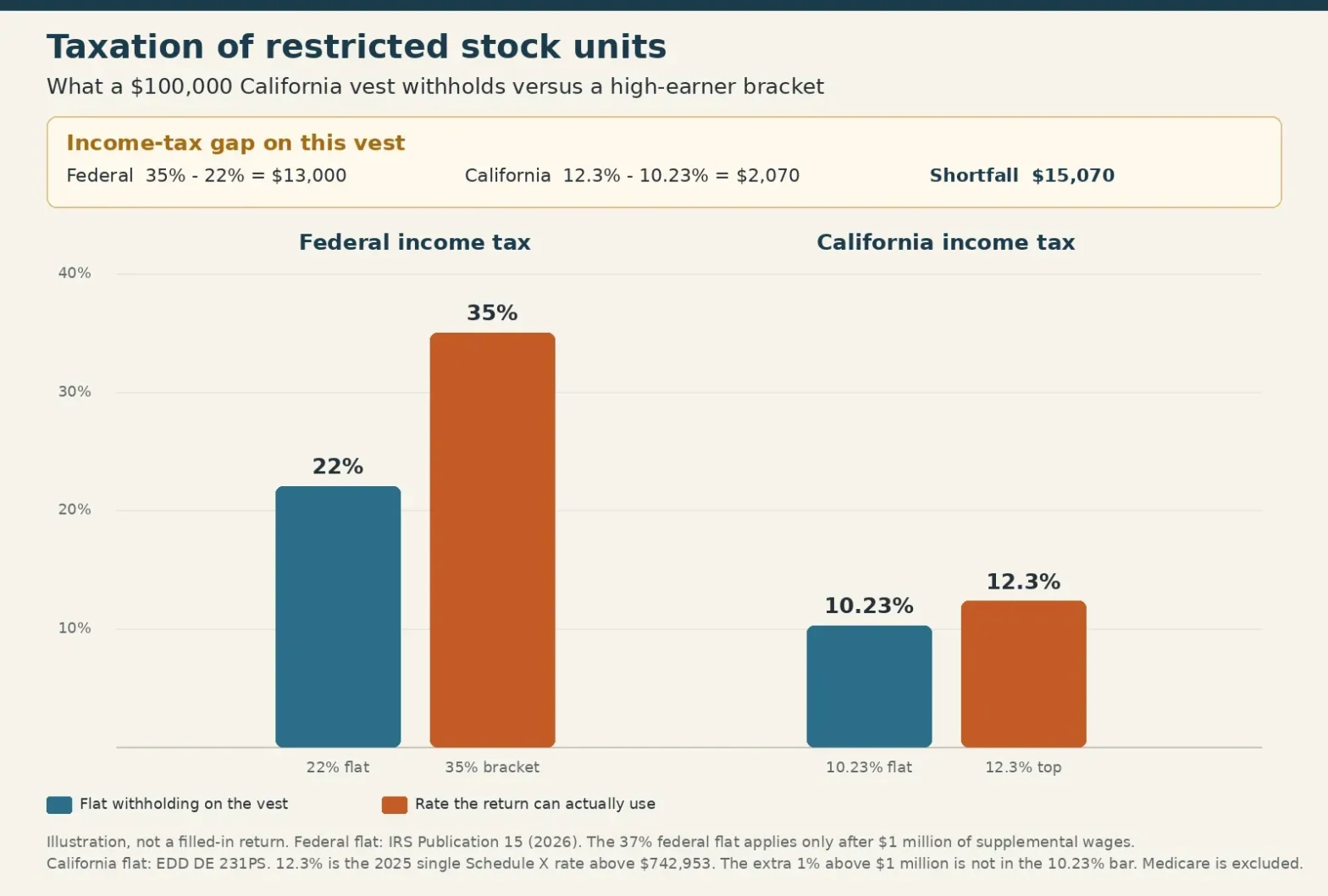
California employees can face a tax shortfall when restricted stock units vest and the cash withheld is too small. Payroll often takes federal income tax at a flat 22% and California income tax at a flat 10.23% on stock and bonus pay. A high earner is often in a higher bracket than either flat rate. Sell-to-cover only funds the amount payroll withheld. The rest is still tax you owe.
A stub that looks like about 35% withheld can still leave a large income-tax balance if most of that percentage is the 22% federal flat plus 10.23% California. Medicare taxes sit inside that percentage and do not close the income-tax gap. The taxation of restricted stock units splits into two bills: wage income on vest day, then capital gain or loss if you sell later. This page is about the first bill.
Review the tax on your next RSU vest with Clear Peak.
How the taxation of restricted stock units starts at vest
Restricted stock units become wage income when they vest and the company delivers the shares. IRS Publication 525 treats property you receive for services as income once it is substantially vested. The amount is the fair market value of the shares, minus anything you paid. For most plans, you paid nothing. That value lands in Box 1 of Form W-2.
Holding the shares does not delay that income. Selling them later creates a separate capital gain or loss measured from the vest-day price. The wage income is already fixed. The vesting-versus-sale overview covers that second bill. This page stays on the cash payroll did not collect for the first one.
Federal withholding on the vest follows the supplemental-wage rules in the 2026 IRS Publication 15. It does not follow your marginal bracket. The optional flat rate is 22%. If supplemental wages paid to you in the calendar year exceed $1 million, withholding on the excess is 37%.
California uses its own flats. The Employment Development Department’s DE 231PS says employers may withhold personal income tax at 10.23% on stock options and bonuses paid apart from regular wages. That rule has applied since November 1, 2009. Other supplemental pay, such as overtime, uses 6.6% instead.
Those flats are a payroll method. They are not the tax on your return. A single California employee can already be in the 32% or 35% federal bracket before the vest. The California bracket on the same dollars can sit well above 10.23%. The gap between those pairs of rates is the shortfall.
One more California layer does not show up in the 10.23% flat. The extra 1% tax, formerly called the Mental Health Services Tax, applies once California taxable income is over $1 million. Payroll withholding does not compute that extra 1%. It appears when the return is prepared.
Which payroll taxes sit beside the income-tax flats
Income-tax withholding is only part of the vest stub. FICA is collected as well, and it does not reduce the income-tax shortfall.
For 2026, Social Security tax is 6.2% of wages up to $184,500. Medicare tax is 1.45% with no wage cap. IRS Topic 751 states both rates and that wage base. If your salary already passed the Social Security cap, the vest may show Medicare withholding only.
Employers must also withhold the 0.9% Additional Medicare Tax once they pay you more than $200,000 in the year. Filing status does not change the employer’s duty. IRS Topic 560 says the employer starts in the pay period that crosses $200,000 and continues through December.
Your return recomputes that 0.9%. The return threshold is $200,000 for single filers, $250,000 for a joint return, and $125,000 for married filing separately. A married couple can be under-withheld or over-withheld on this line even when each stub looks right. There is no employer match on the extra 0.9%.
Do not subtract Medicare taxes from the income-tax gap. They are a separate tax. Count only the 22% federal line and the 10.23% California line when you ask whether income-tax withholding covered the vest.
How a $100,000 California vest can miss the bracket
Maya is a single California hospital employee. Her salary is already above the 2026 Social Security wage base of $184,500, so Social Security withholding for the year is finished. Her employer is already withholding Additional Medicare Tax. In June, 1,000 RSUs vest at $100 a share.
The vest is $100,000 of wages. She pays nothing for the shares. The employer uses sell-to-cover and the flat supplemental rates. The table uses those published rates on this one vest. It is an illustration, not a filled-in return.
| Item on the $100,000 vest. | Rate. | Amount. |
|---|---|---|
| Federal supplemental withholding. | 22 percent. | $22,000. |
| California stock and bonus withholding. | 10.23 percent. | $10,230. |
| Medicare tax. | 1.45 percent. | $1,450. |
| Additional Medicare Tax. | 0.9 percent. | $900. |
| Total withheld through sell-to-cover. | 34.58 percent. | $34,580. |
| Shares retained before any later sale. | Not a rate. | About 654 shares. |
Sell-to-cover sold about 346 shares and sent that cash to the tax agencies. Maya still holds the shares that were not sold. Her cost basis in every share from this vest is the vest-day price, including the shares sold to cover taxes. A later sale above or below that price is capital gain or loss. It is not a second tax on the wage value of the vest.
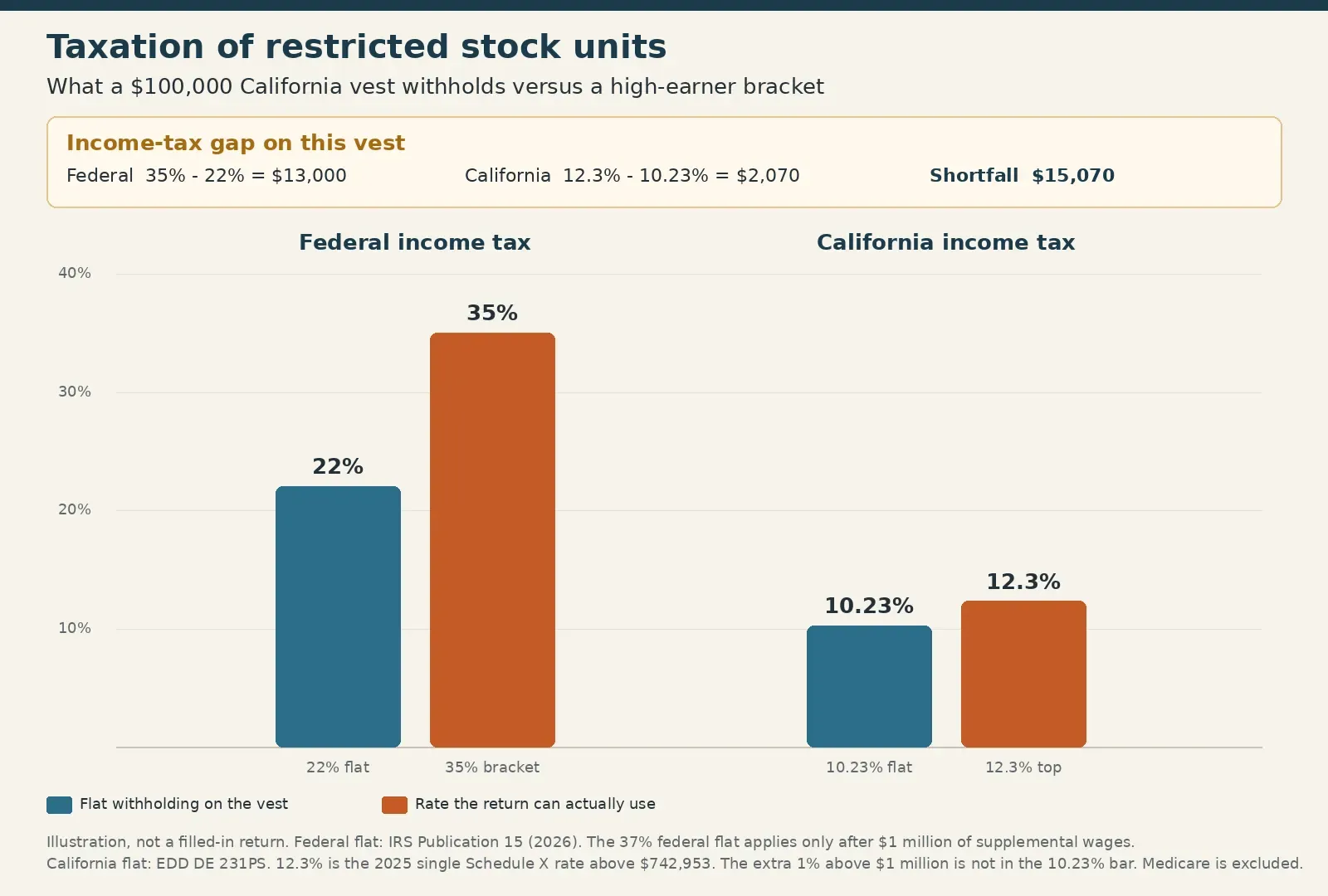
Now compare withholding with a plausible bracket. If this vest is taxed at 35% federally, the 22% flat leaves $13,000 of federal income tax. If California taxes the same dollars at the 12.3% top rate, the 10.23% flat leaves about $2,070. Together that is about $15,070 of income tax still due, before the extra 1%.
The 12.3% figure is the top rate on the 2025 California Schedule X for single filers, the rate that applies above $742,953 of taxable income. Use the 2026 bracket page for professionals when you need the current-year thresholds. This page does not reprint those tables.
Medicare taxes do not close that gap. If the vest pushes California taxable income over $1 million, add 1% of the amount over that line. Credits, deductions, other equity, and filing status will change Maya’s real number. The shape of the gap will not. Flat 22% and flat 10.23% are below the brackets many California RSU holders actually face.
What changes the size of the gap
The same 1,000 shares can produce a very different shortfall. Price, other wages, and the employer’s withholding method all move it.
The employer may not use the flat rate
Publication 15 lets the employer add supplemental wages to regular wages and withhold as if the total were one paycheck. DE 231PS allows the same combined method for California. A vest paid in the same check as salary can therefore be withheld at a higher rate than 22% and 10.23%.
That is better, and it can still be short. The combined method looks at one pay period. It does not know your spouse’s income, a bonus later in the year, or the 1% tax over $1 million of California taxable income.
A second vest can flip the federal rate
Federal withholding jumps to 37% only after supplemental wages for that employee pass $1 million in the year. A vest well below that line stays at 22% even if salary is already high. A later vest that crosses the line is withheld at 37% on the excess only.
California’s 10.23% stock-and-bonus flat does not step up at $1 million. The extra 1% is computed on the return, not in the flat withholding rate.
Moving during the vesting period
If you worked partly outside California between grant and vest, California may tax only the workday slice tied to this state. Flat withholding can still be taken on the full federal wage amount. Those are different rules.
Size the state payment from the California-source portion. Do not assume the 10.23% line on the stub equals California’s share of the tax. The workday ratio is covered on the sourcing page, not here.
Filing status and a spouse’s income
Payroll withholds from your wages alone. A joint return stacks both spouses’ income. Two working spouses can each see 22% federal withholding and still owe at the 35% bracket on the combined return.
The reverse happens too. A vest withheld at 37% late in the year can overshoot if other income is lower than payroll assumed. Compare the stub with the return you expect to file.
How to close the shortfall before April
Do the math in the week of the vest. Waiting until the W-2 arrives does not change the tax, and it can put you past an estimated-tax date.
- Read the vest statement for the share price, the shares delivered, and each tax withheld.
- Separate federal income tax, California income tax, Social Security, and Medicare. Keep Medicare off the income-tax line.
- Add the vest to expected wages and find the federal and California brackets on those extra dollars.
- Subtract income-tax withholding from that estimate. The difference is the shortfall to cover.
- If you moved during the grant-to-vest window, apply the California workday slice before you size the state payment.
- Choose extra withholding or a quarterly estimate, and save the confirmation with the vest statement.
Extra withholding on a later paycheck is often the simpler cash fix. Withholding is generally treated as paid evenly through the year. A quarterly estimate has to land in the right period. Use the California income tax withholding calculator to test the rest of your W-2 picture. Use the estimated tax rules for high-income Californians for safe harbors and due dates. Neither page prices an RSU vest.
Net-share settlement and sell-to-cover both fund only the withheld amount. They do not fund your marginal tax. Selling more shares on vest day can raise cash for the shortfall. That extra sale is a capital gain or loss against the vest-day price. It does not redo the wage income, and it does not erase the shortfall by itself.
If the shortfall is large, write down the dollar figure before you spend the cash from a same-day sale. The shares that remain still have basis. The tax agency does not automatically draft the unpaid balance from the brokerage account.
What to keep so the same income is not taxed twice
Match three records before you file. The W-2 should include the vest in Box 1 and the federal and California withholding you already paid. The brokerage statement shows shares withheld or sold and the basis the broker stored. Your vest confirmation shows the price the employer used.
Basis in the shares is that vest-day fair market value, spread across the shares delivered before sell-to-cover. If the broker’s basis is blank or zero, the return can tax the wage income again as a gain when you sell. That is a reporting miss, not a second tax on the shares.
Keep the pay stub that lists the 22% and 10.23% lines, or the combined-method amounts if payroll used those. You will want them if the W-2 withholding totals do not match what you remember sending. Also keep any estimated-tax confirmation so the return claims the payment you already made.
A second class of equity does not belong on this worksheet. An option exercise uses a different spread, a different basis, and sometimes the alternative minimum tax. Park that event on the restricted stock units versus stock options page. The wider calendar, when RSUs sit next to other equity, lives on the equity compensation tax planning page.
Primary sources for the rates used here:
- IRS Publication 525 covers property transferred for services and when it is income.
- IRS Publication 15 (2026) sets the 22% and 37% supplemental withholding rates.
- EDD DE 231PS sets California’s 10.23% flat on stock options and bonuses.
- IRS Topic 751 states the 2026 Social Security wage base of $184,500 and the 6.2% and 1.45% rates.
- IRS Topic 560 explains the 0.9% Additional Medicare Tax and the $200,000 withholding trigger.
- FTB 2025 Tax Rate Schedules show the 12.3% single rate above $742,953.
Where the rest of the RSU question lives
This page is only the withholding gap on vest-day wage income. It does not replay how a grant vests, and it does not walk through a stock sale.
How RSUs work for California employees covers the grant, the vest, and what happens if you leave. Use the vesting-versus-sale page linked above for ordinary income, basis, and the later capital gain. Use this one to size the check that flat withholding did not collect, then decide whether the cash should go through payroll or a quarterly payment.
Ask Clear Peak to size the tax on your next vest.
Frequently asked questions
Does sell-to-cover pay the full tax on a California RSU vest?
It pays the tax the employer withheld. That is often 22% federal plus 10.23% California, along with Medicare. If your brackets are higher, you still owe the difference.
Is the 22% federal rate the tax on RSU income?
No. IRS Publication 15 for 2026 sets 22% as the optional flat withholding rate on supplemental wages. The rate becomes 37% only after supplemental wages for the year pass $1 million. Your return uses your actual bracket.
Why does California withhold 10.23% on RSUs?
EDD allows a 10.23% flat on stock options and bonuses when that pay is withheld apart from regular wages. Other supplemental wages, such as overtime, use 6.6%. The employer may instead combine the vest with regular wages.
Do I owe tax if I never sell the shares?
Yes. The vest is wage income whether you sell or hold. Keeping the shares only means the cash for withholding, and for any shortfall, has to come from somewhere else.
Can I wait and pay the shortfall with my return?
You can, but a large balance can bring an underpayment penalty. Extra withholding or a timely estimated payment usually costs less than waiting until April to pay the whole gap.